If you've typed "am I being gaslit?" into Google at 1am, take a breath. The fact that you're asking is worth paying attention to — not because you're paranoid, but because gaslighting is designed to make you question yourself. That's the whole point of it.
Gaslighting is a form of manipulation where someone makes you doubt your own memory, perception, or sanity. The term comes from a 1938 play (and the 1944 film Gaslight) where a husband slowly convinces his wife she's losing her mind.
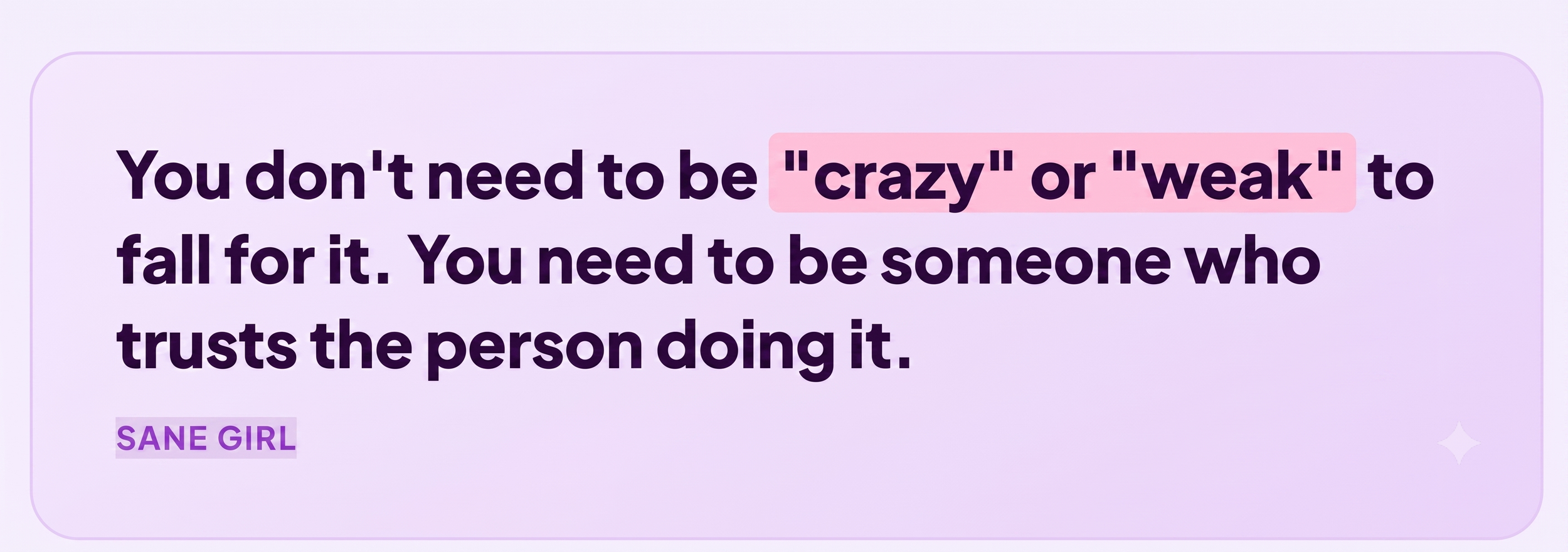
Here's the thing most articles won't tell you: you don't need to be "crazy" or "weak" to fall for it. You need to be someone who trusts the person doing it. That's it.
9 signs you might be experiencing gaslighting
1. You apologize constantly. You say sorry before you even know what you did wrong — it's become a reflex, a way to defuse tension before it builds. Over time, "sorry" stops being an apology and starts being a survival habit.
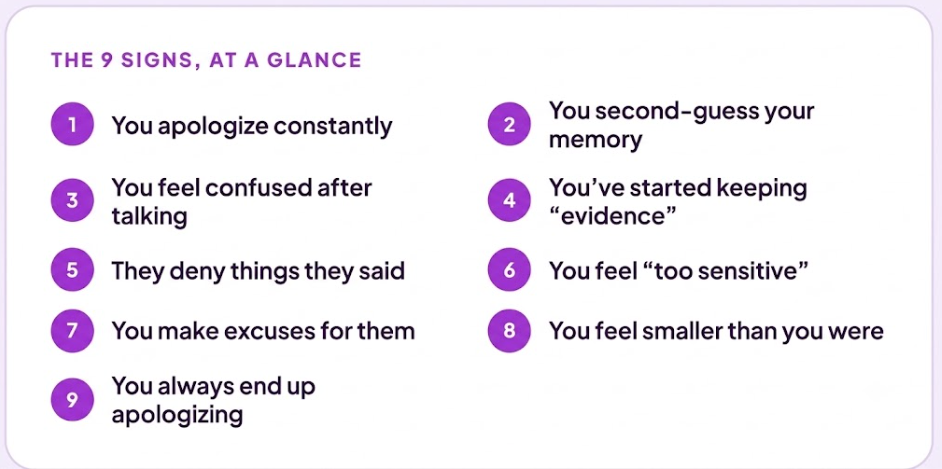
Read one, and it's easy to explain away. Read all nine, and a pattern shows up — and the pattern is the thing that's hard to argue with, even inside your own head.
2. You second-guess your own memory. Conversations that happened yesterday feel slippery. You replay them trying to pin down what was actually said, because someone keeps insisting it went differently than you remember.
3. You feel confused after talking to them. You walk away foggy and off-balance, like the floor moved but you can't point to how. That disorientation isn't random — it's often the residue left behind by manipulation.
4. You've started keeping "evidence." Screenshots, notes, saved messages — not because you're dramatic, but because some part of you needs proof that it actually happened. (If you're doing this, listen to it.)
5. They deny things you know they said. "I never said that." "You're imagining things." Flat denials of things you clearly remember, delivered with total confidence.
6. You feel like you're "too sensitive." You've been told it so many times that you've started pre-emptively doubting your own reactions — wondering if you're overreacting before you've even reacted. There's a name for what that phrase does, too.
7. You make excuses for them. To friends, to family, to yourself. You've gotten good at explaining away behavior that, said out loud, you know you wouldn't accept from anyone else.
8. You feel smaller than you used to. Less sure, more anxious, quieter. People who knew the old you have noticed you've dimmed.
9. Somehow, you always end up apologizing. You raise a problem and the conversation flips until you're the one saying sorry. That flip has a name — it's called DARVO, and it's one of the most common gaslighting patterns there is.
The first time I experienced gaslighting I felt like I was going crazy — trying to prove what I'd said, over and over. I couldn't believe someone I thought cared about me would deliberately distort my own words back to me. For the longest time I was sure it was a misunderstanding — that if I were just clearer, or put it in an email, or had someone else in the room, it would resolve.
It didn't. Because the confusion wasn't the problem to solve. It was the point.

Sound familiar?
You don't have to make a decision today. The first step is simply seeing it clearly — gaslighting loses much of its power the moment it has a name.
Write it down when it happens— and somewhere they can't touch. The date, what was said, how you felt. Not to "win," but so you have something solid to hold onto when the fog rolls back in. Memory is fragile under stress; a timestamped record isn't. Note: This is exactly what Sane Girl’s Reality Vault is for — a private, timestamped log only you can open. It's always free, because keeping your own receipts shouldn't cost anything.
Stop trying to win the memory argument. You won't out-argue someone committed to denying it, and every round chips away at you. The goal isn't to convince them — it's to keep your reality intact. Saving the moment somewhere private does more for you than any comeback would.
Find one outside mirror. A friend, a therapist, a journal — someone or something that reflects your experience back without distortion. And if the people around you are tired of hearing it, that's what the Sane Girl community is for: a place to be believed by people who've been there, without having to name anyone or explain the whole history.
How Sane Girl detects gaslighting in text messages
You've read the articles. Watched every video on gaslighting. You can define it in your sleep — and none of it helps at 1am when it's happening to you and you can't tell which way is up. Reading about gaslighting in the abstract is one thing. Seeing it named in your own conversation is another.
Here's what that looks like inside Sane Girl.
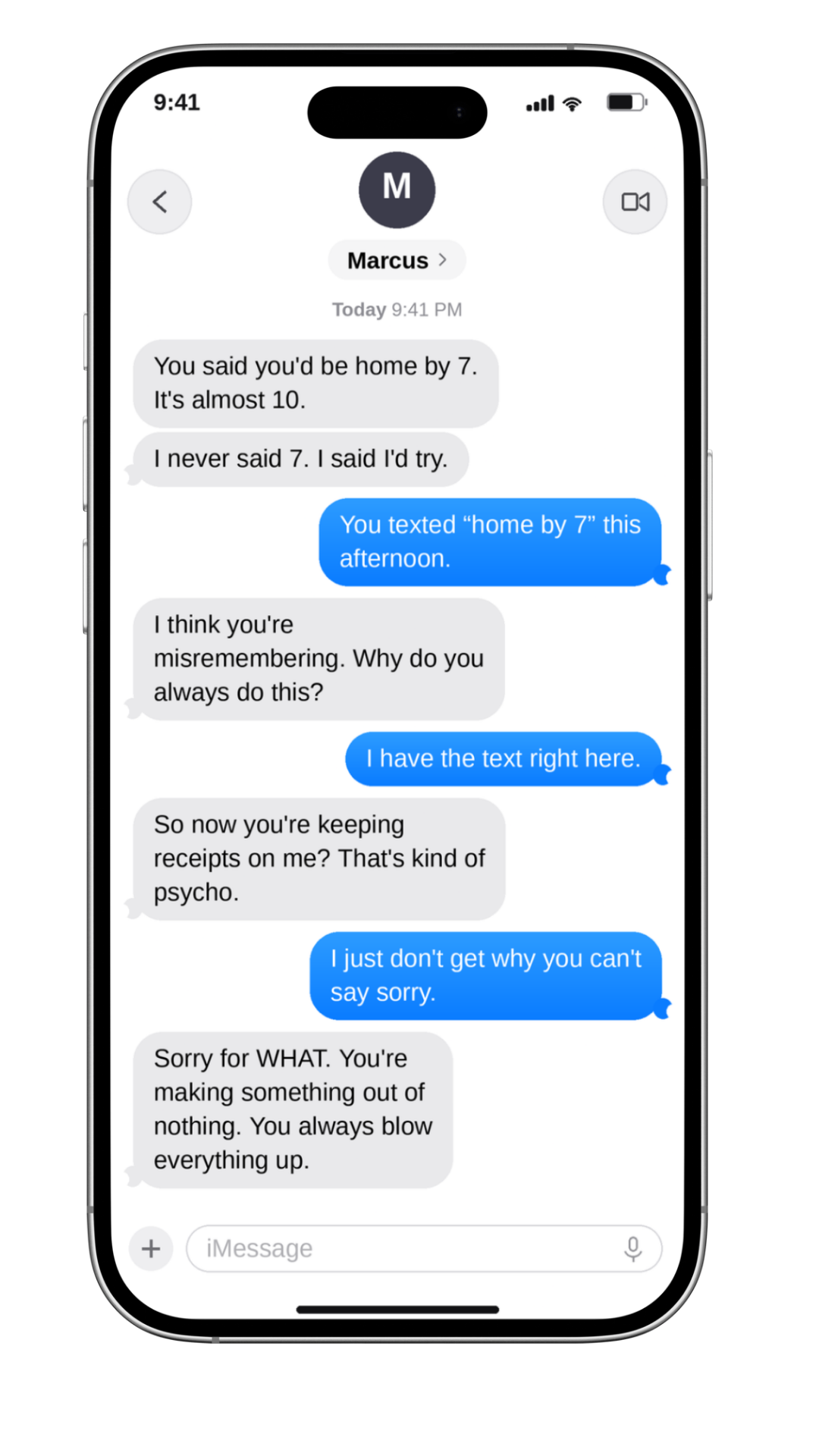
You paste in or upload the message — the text, the DM, the screenshot
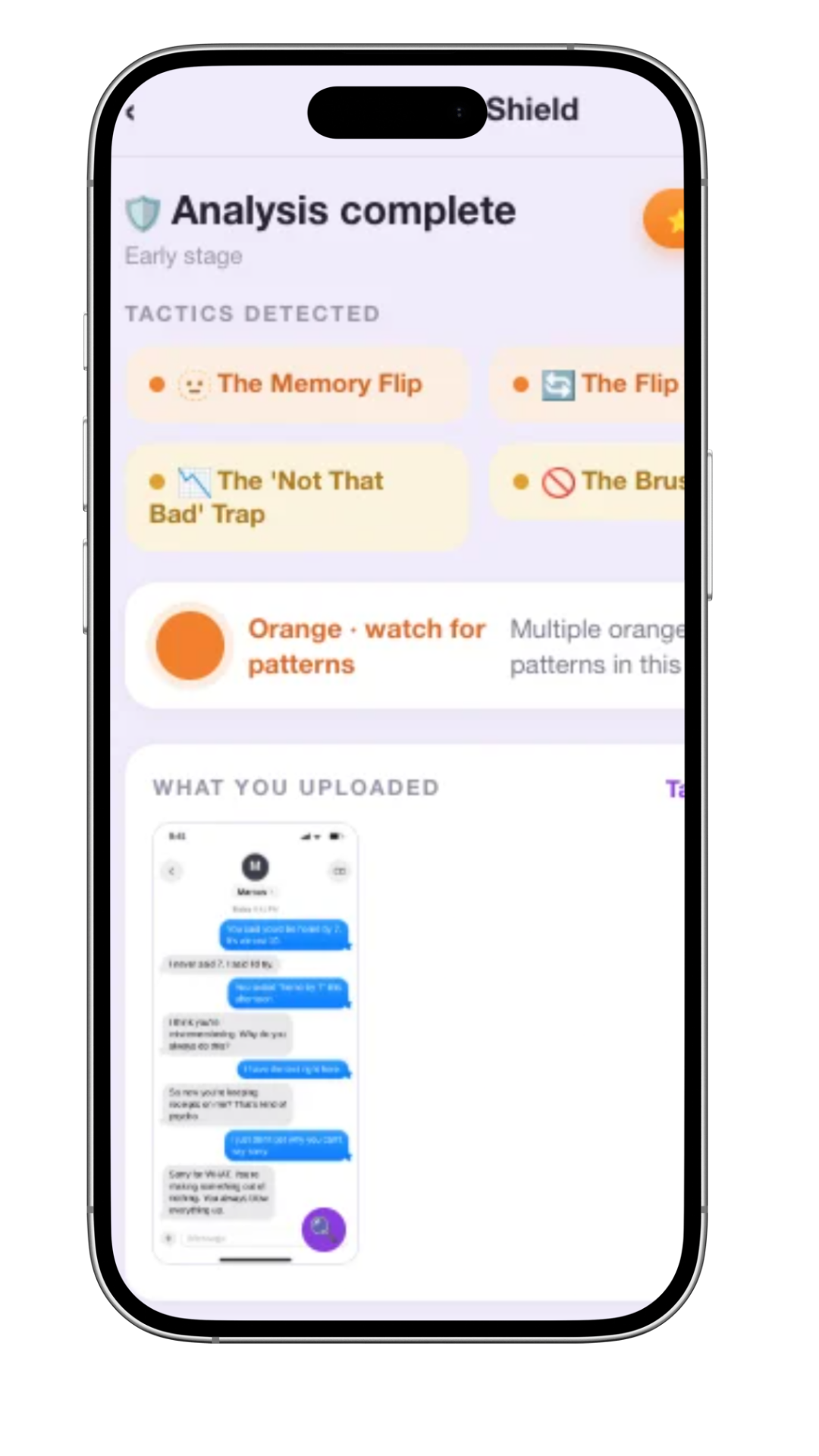
Sane Girl's Clarity Shield reads it against a library of manipulation tactics and flags what's happening in plain English.
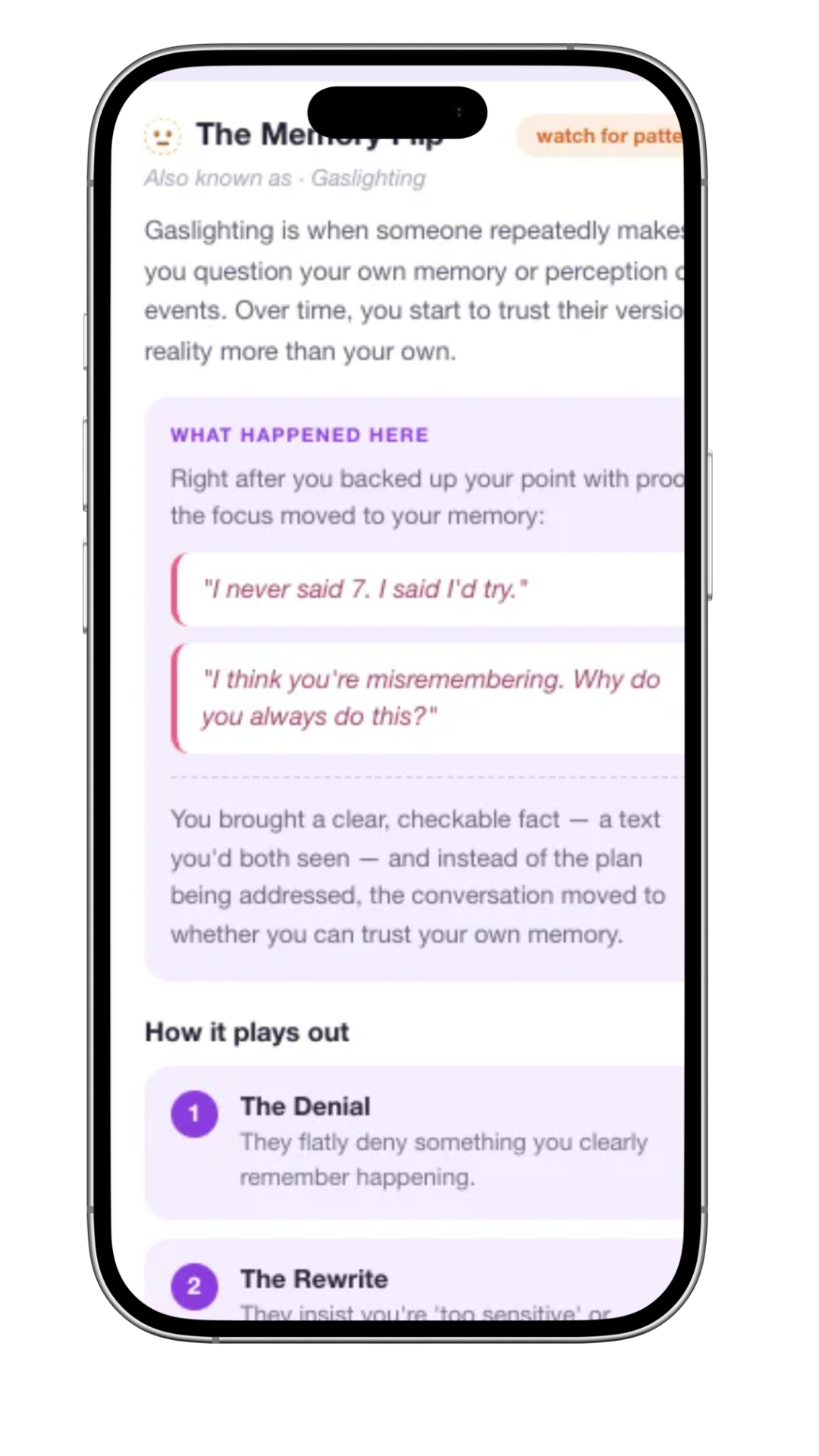
It names the tactic — here, the memory flip — and quietly saves the receipt to your private Reality Vault.
Then, because naming it can stir everything up, it hands you straight to the Coping module: a breathing exercise, a grounding tool, or just a reminder that your gut still gets a vote. Clarity first, then care.
Reading what was really going on can stir up a lot. That's what the Coping Guide is for — so you're never left to sit with it alone.